



How to Translate a Website: 8 Steps for Global Growth
How to Translate a Website: Your Guide to Reaching Global Audiences

Updated on February 18, 2026

Why Website Translation is Necessary for Global Expansion
A well-translated website allows businesses to connect with international audiences, increase revenue, and establish credibility in new markets. With 64% of websites publishing content in English, companies that invest in website translation gain a significant advantage by reaching non-English-speaking consumers more effectively.
Beyond accessibility, translating a website helps improve search engine rankings, conversion rates, and customer engagement by offering a localized experience. But how can businesses translate a website efficiently while maintaining accuracy, SEO value, and cultural relevance?
Step 1: Define Target Markets and Languages
Although it might be tempting, don’t let your gut feeling drive how you decide who you are translating for. Always let data drive the decision.
Starting with your website analytics, look for countries where you’re getting meaningful traffic volume but low conversion rates. If non-English markets are already searching for you, all you need to do is meet them where they are.
Beyond analyzing existing traffic, you should look at e-commerce spending data by region. This will help you assess revenue potential and help you prioritize markets with fast-growing digital spending.
Once you’ve identified several markets and languages, you can begin a phased rollout. Taking a measured, refined approach will help you reduce risk and build a high-quality localization process before scaling.
Step 2: Audit Content and Prioritize Pages
There’s no need to translate all of your content right away —in fact, doing so is a quick way to blow your budget on low-impact content. Instead, always start witha content audit.
Creating a spreadsheet that prioritizes high-impact pages will ensure a cost-effective, strategic approach. Here’s what to focus on:
- High Priority: Home Page, product and service pages, pricing, checkout, and top 10 content posts by organic traffic.
- Medium Priority: About page, FAQ, contact, and secondary landing pages
- Low Priority: Archive pages, older content posts, and anything internal-facing.
During a content audit, it’s also a great time to streamline content and cut jargon to help simplify the translation process.
Step 3: Choose Your Translation Method
Choosing the right translation method will depend on your content type, budget, and quality expectations.
Human Translation: Accuracy and Cultural Sensitivity
For businesses prioritizing high-quality translations, human translation remains the best option. Professional linguists understand industry-specific terminology and cultural nuances, ensuring that translations are not just accurate but also resonate with local audiences.
This method is ideal for marketing materials, legal documents, and highly specialized industries, but can be more time-intensive and costly than automated solutions. Although human translation ensures quality, you should expect a higher cost and turnaround time.
Machine Translation: Fast and Scalable
For companies managing large volumes of content, machine translation (MT) offers speed and efficiency. Tools like Google Translate and DeepL provide quick, automated translations, making them useful for internal documentation and non-customer-facing content.
However, MT lacks contextual accuracy and may struggle with industry-specific language or nuanced phrasing. Businesses often use machine translation with human post-editing to refine content quality while maintaining efficiency.
Hybrid Translation: Combining AI with Human Expertise
The most efficient approach for scaling website translation is a hybrid model, where AI-powered translation is supplemented with human editing.
This approach:
- Reduces time and costs compared to full human translation.
- Improves accuracy and cultural sensitivity compared to machine-only translation.
- Ensures consistency across multiple languages and regions.
This method is particularly beneficial for e-commerce sites, global enterprises, and businesses with ongoing content updates.
Step 4: Set Up Your CMS and Technical Infrastructure
Before you can publish any translated content, you need to make sure your CMS is compatible with the translation software you choose.
Businesses should look for cloud-based translation software that offers: CMS compatibility for seamless integration, translation memory to ensure consistency across pages, and automated quality assurance tools to improve accuracy.
Bablic provides API-based automation, CMS integrations, and advanced management tools to help businesses scale website translation effortlessly.
In addition to integrating your CMS and translation software, you should ensure you’ve implemented hreflang tags. Each localized page will need an hreflang tag pointing to all its language equivalents. Without these HTML attributes, search engines may not serve the right version of a page to the right user, causing all your translation investment to go to waste.
Step 5: Localize Beyond the Words
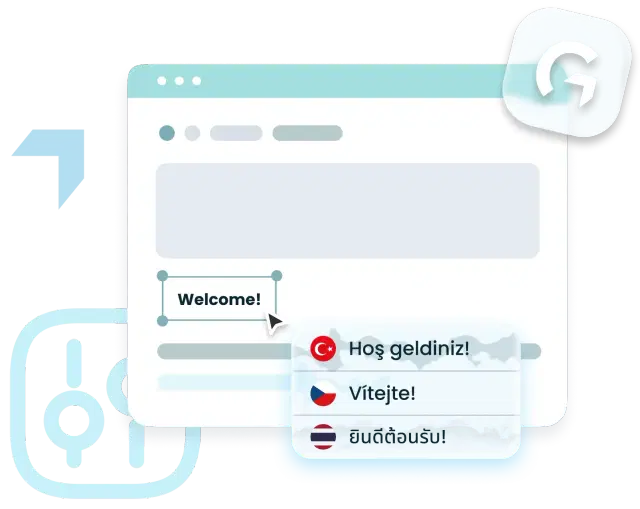
Translation alone is not always enough to create an engaging user experience for global audiences. Website localization is about gaining a competitive advantage and involves adapting content, design, and functionality to match local cultural preferences.
Key localization considerations include:
- Currency, date formats, and measurement units tailored for each market.
- Cultural adaptation of images, colors, and messaging to align with regional expectations.
- Optimized navigation and user experience to accommodate different reading patterns (e.g., right-to-left languages).
A localized website ensures that international visitors feel connected to the brand, leading to higher engagement and trust.
Step 6: Implement Multilingual SEO
A successful multilingual website will require search engine optimization (SEO). Even the most beautifully translated site can go completely unnoticed by search engines and AI searches if the technical signals are absent.
Best SEO practices include:
- Using hreflang tags to indicate language and regional targeting to search engines.
- Conducting region-specific keyword research to optimize translated content.
- Creating localized URLs to improve search rankings in different languages.
- Building international backlinks to strengthen domain authority across global markets.
By implementing these strategies, businesses can increase organic traffic, improve user experience, and maximize conversions in international markets.
Step 7: Test, QA, and Launch
Always QA before launching—translation errors on customer-facing pages are embarrassing and can quickly damage credibility.
Technical QA Checklist:
- Navigate every translated page and confirm content renders in the target language.
- Test the language switcher from multiple pages and verify it sends users to the equivalent localized page, not the homepage.
- Verify hreflang tags reference the correct alternates.
- Test forms, sign-up flows, and checkouts in every language — including labels, validation error messages, and confirmation emails.
- Check for text overflows and broken UI elements, including images, untranslated alt texts, and dynamic strings that slipped through.
Human QA Checklist:
- Have a native speaker do a complete walkthrough of the purchase and contact flow.
- Look for awkward localized idioms.
- Check that CTAs are grammatically correct and not culturally off-putting.
- Ensure all product descriptions sound natural.
Step 8: Maintain and Scale
Launching your multilingual site is the starting line, not the finish. Every new piece of content can cause a drift between your source and translations. If left unmanaged, without an updating process in place, translations can go stale and become inconsistent.
The most effective team will embed localization updates into the regular content publishing workflow.
Some translation software, such as Bablic, offers translation memory tools that will store previously translated segments and reuse them automatically on future content — helping reduce your costs per word and increase turnaround time.
How Bablic Helps Businesses Translate Websites
As part of TransPerfect, the world’s largest provider of translation technology and services, Bablic simplifies website translation by combining AI-powered automation with expert linguistic oversight.
Key Features of Bablic:
- CMS Integrations – Works seamlessly with WordPress, Shopify, and Adobe Experience Manager.
- Hybrid AI + Human Translation – Balances speed, efficiency, and accuracy.
- SEO Optimization – Ensures translated content ranks in global search results.
- Translation Memory & Workflow Automation – Saves time and reduces costs.
- Brand Management Tools – Maintains consistent messaging and terminology across languages.
By leveraging cutting-edge translation and localization technology, Bablic allows businesses to expand globally without compromising content quality.
Need Help Translating Your Website?
With Bablic, businesses can scale website translation effortlessly, ensuring accuracy, cultural relevance, and SEO optimization.
Find Your Answers Here
Yes, translating your website allows you to enter new markets and connect with audiences in different countries. By delivering content in multiple languages, you can reach a broader audience based on your target regions.
Our platform leverages cutting-edge translation and localization technology to facilitate workflows and improve the accuracy of your translations. This ensures effective international communication and higher-quality content.
Bablic provides brand management tools that help enforce style guides and branded terms across all translated content. This ensures that your brand voice and tone are maintained consistently.
Bablic offers easy integration with your preferred CMS platform, ensuring a seamless translation process that fits within your existing tech stack.
Translation Memory saves time and effort by storing translated phrases and sentences for future use. It improves the quality and consistency of translations and reduces the workload for translators.
Google Translate is a free machine translation tool, though it may lack the accuracy and cultural nuances provided by professional human translation.
Using a Global Translation Memory system can help maintain consistency by storing and reusing previously translated content. This ensures that high-value keywords and terms remain consistent across all translations.
An SEO-friendly translation involves adapting your website’s content to rank higher in the SERPs for each target language. This includes using relevant keywords and ensuring that the translated content meets local search engine optimization standards.
Yes, for a fully localized user experience, it’s important to translate your website’s URLs along with the content. Google recommends using different URLs for each target language to help users find and navigate your website in their native language.



Explore Our Solutions

About
We created GlobalLink because we believe that all businesses great and small should have a beautifully translated and localized website.

© 2026 TransPerfect | All Rights Reserved